The phrase does not establish a casino licence; this guide explains how to assess promotions, reviews, machine context and access claims.
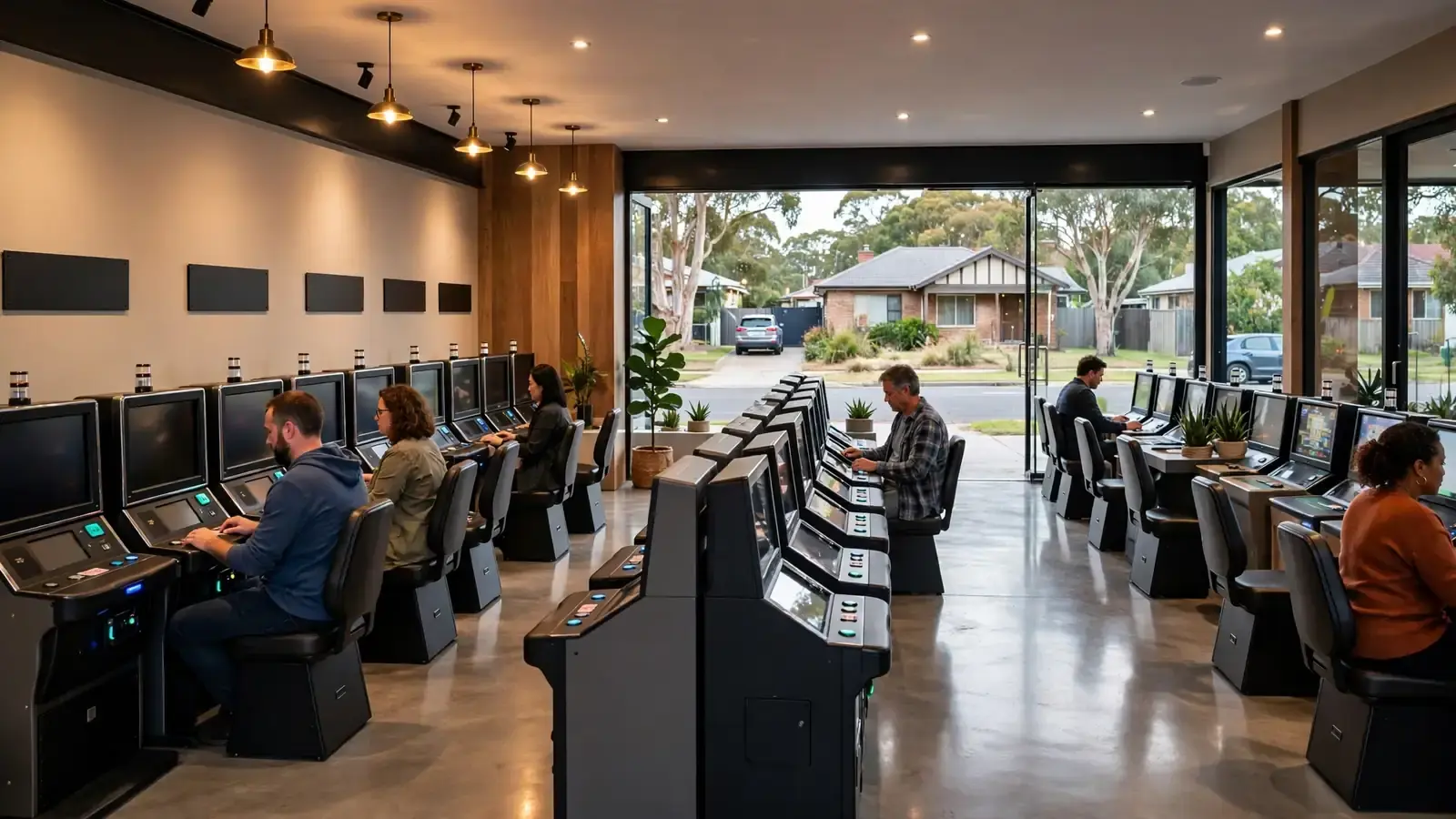
What a Pokies Parlour Means in Australia
“Pokies parlour” is an informal phrase, not a reliable description of a venue’s legal status. In Australian usage, “pokies” refers to gaming machines, while “parlour” can appear in the name of a business or entertainment venue. Neither word, by itself, establishes that a place is a casino or that it holds a casino licence.
The distinction matters because a search result or business name can make very different places sound alike. It does not treat every business that uses “parlour” in its name as an Australian casino. The name is a label; the venue’s status depends on the relevant jurisdiction and its licensing arrangements.
Casino regulation in Australia sits with state and territory governments. Each casino property operates under a licence issued by its local jurisdiction. That framework is more useful than the wording on a sign or webpage: it tells you that “casino” is a regulated category, rather than a description that any venue can establish simply by adopting the word.
The scale of the sector is sometimes described as more than 20 full-scale casinos across Australia, with coverage across all eight states. That count comes from a specialist review, so it should be read as a sourced snapshot rather than a permanent definition of the market. Casino numbers can change as properties open, close or change status; the phrase “full-scale casino” also distinguishes these properties from businesses whose names happen to include “parlour.”
Choosing a pokies parlour casino in Australia means checking the details that matter to you before you play. Use this list as a reference point and review each operator’s terms and availability for your location.
-
LuckyVibe
- License
- Curacao Gaming Control Board OGL/2023/176/0095 (Hollycorn N.V.)
LuckyVibe is listed with a Curacao Gaming Control Board licence, OGL/2023/176/0095, held by Hollycorn N.V.
-
Lucky Dreams
- License
- Curacao
- Min. deposit
- A$20 (POLi)
Lucky Dreams is listed with a Curacao licence and a minimum deposit of A$20 via POLi.
-
LevelUp Casino
- License
- Curacao eGaming OGL/2023/174/0082 (Dama N.V.)
- Min. deposit
- A$15
LevelUp Casino is listed with a Curacao eGaming licence, OGL/2023/174/0082, held by Dama N.V. Its minimum deposit is A$15.
-
Playfina Casino
- License
- Curacao eGaming (Hollycorn N.V., since 2017)
- Min. deposit
- A$20-30 (depends on the offer)
Playfina Casino is listed with a Curacao eGaming licence held by Hollycorn N.V., dating from 2017. Its minimum deposit is A$20–30, depending on the offer.
-
SpinsUp
- License
- Curacao Gaming Control Board OGL/2023/174/0082 (Dama N.V.)
SpinsUp is listed with a Curacao Gaming Control Board licence, OGL/2023/174/0082, held by Dama N.V.
-
Vegaz Casino
- License
- Curacao OGL/2024/1335/0780
- Min. deposit
- EUR 20
Vegaz Casino is listed with a Curacao licence, OGL/2024/1335/0780. Its minimum deposit is EUR 20.
-
Bizzo Casino
- License
- Curacao Gaming Control Board (TechSolutions Group N.V.)
Bizzo Casino is listed with a Curacao Gaming Control Board licence held by TechSolutions Group N.V.
-
JustCasino
- License
- Curacao Gaming Control Board
JustCasino is listed with a Curacao Gaming Control Board licence.
-
Kingmaker
- Payout speed
- crypto ~90 minutes, fiat 1-5 days
- Min. deposit
- A$30
Kingmaker’s listed payout speed is around 90 minutes for crypto and 1–5 days for fiat. Its minimum deposit is A$30.
-
Roby Casino
- License
- Curacao eGaming (Roby Games Ltd)
Roby Casino is listed with a Curacao eGaming licence held by Roby Games Ltd.
A separate measure gives a more precise view of the machines in casino settings. Australian casino venue licences endorse and have installed a total of 3,308 gaming machines. “Endorsed” means that the machines are covered by the venue’s licence; it does not mean that every casino has the same allocation or that the machines are distributed evenly between properties. The figure is a national total, not a description of any one venue.
That distinction helps make sense of the phrase “casino pokies.” It refers to gaming machines in a casino context, rather than turning “pokies” into a separate category of venue. A casino may have machines as part of its offering, but the presence of gaming machines alone does not make a place a casino. The licence and the identity of the venue are the defining points.
Nor does “parlour” have a single nationwide meaning that overrides local rules. It can be part of a trading name, a sign or an informal description. Readers should therefore avoid inferring a venue’s status from that word alone. A business that sounds like a parlour casino is not necessarily a licensed casino, and a licensed casino need not use “parlour” in its name.
 Highest Payout Online Casino in Australia: What It MeansLearn how game return rates differ from casino-wide payout claims, and why a stated percentage cannot predict an individual result or confirm…
 Playson Casinos in Australia: Bonus Rules ExplainedLearn how Playson slot bets contribute to wagering requirements, why bonus balances are not immediately withdrawable, and which offer conditions still apply.
The distinction is particularly relevant when a phrase combines the words “pokies,” “parlour” and “casino.” Read naturally, it might refer to a casino where gaming machines are available. But the wording is not proof of a particular property, its licence or its machine count. Those are separate facts, and a name cannot substitute for them.
In everyday conversation, people may use “pokies venue” broadly for places with gaming machines. A casino is narrower: it is a property operating under a casino licence issued by its state or territory. Keeping those meanings apart avoids confusing a familiar term for machines with the regulated status of a venue.
For a reader trying to identify what a “pokies parlour” means in Australia, the practical starting point is thus the physical setting and the venue category. If the subject is a casino, the relevant context is a licensed casino property and its machines—not the mere presence of the word “parlour.” Australia’s national casino-machine total provides scale, while the individual property’s licence defines its own position.
Sign-Up Bonuses: Check the Conditions, Not the Headline
A sign-up bonus or no-deposit bonus can sound like a simple addition to an account. The headline may suggest that a new customer receives something merely for registering, or that no payment is needed to get started. But promotional wording is not a complete description of the conditions, and it is not evidence that the service is authorised to operate in Australia.
Legal Prohibition
Australian law prohibits operators from providing real-money online casino games to people in Australia, regardless of any sign-up bonus offers.
That distinction matters especially for online casino claims. Australian law prohibits operators from providing real-money online casino games to people in Australia. A bonus attached to such a service does not change the legal position. Nor does calling it a “parlour” make an online casino an Australian casino venue.
Read the terms as part of the claim
If you encounter a sign-up promotion, treat the full terms as essential context, not fine print to consult after deciding that the headline sounds attractive. Check what the promotion says it applies to, who can receive it, what actions are required, and whether there are conditions on using or withdrawing any associated funds. If those details are unclear, inconsistent or difficult to find, the headline alone cannot resolve the uncertainty.
“No deposit” also needs careful reading. It describes a claim about the starting point, not necessarily the whole arrangement. The accompanying terms may set out eligibility requirements, account restrictions or other conditions. A phrase that sounds unconditional may be qualified elsewhere. If the conditions cannot be understood before you engage with the service, you cannot assess the claim from its headline.
This is not a reason to work out how to use an offer. It is a way to avoid treating promotional language as a reliable account of what a service does or permits. A bonus may be presented as a benefit, while its practical meaning depends on conditions that are less prominent than the headline.
 Golden Pokies Casino in Australia: Legal GuideLearn what Golden Pokies refers to, how Australian law treats offshore casino offers, and why ACMA regulates providers rather than individual players.
 RTG Casinos in Australia: Access, Rules and RisksLearn how RTG software relates to offshore casino access, bonuses and withdrawals, and why the Interactive Gambling Act 2001 restricts operators serving…
A promotion does not prove authorisation
A professional-looking offer, a functioning registration page or an active customer account does not establish that an online casino is licensed in Australia. The same applies if a site remains accessible or appears under another domain. Access and account traffic say something about a website’s operation; they do not establish Australian authorisation.
This point is easy to miss because a promotion can look like evidence of an organised business. It is not evidence of lawful authority. A service can describe a bonus in confident terms without that description proving that it may provide online casino gambling to people in Australia. The wording and the service’s legal status are separate questions.
For a physical casino, licensing is handled by the relevant state or territory. That system should not be assumed to create a locally licensed market for online casinos: real-money online casino services are prohibited for operators under Australia’s federal framework. So a reader should not interpret a bonus as an invitation from an Australian-licensed online casino simply because the site uses Australian language, refers to local customers or presents a familiar casino style.
Separate the sales claim from the legal question
When assessing a bonus claim, keep two checks distinct. First, ask what the promotion actually promises and what conditions shape that promise. Second, ask what kind of service is making the claim and whether it is permitted to provide that service in Australia. Clear terms cannot answer the second question; neither can an appealing headline.
Do
- Treat the full terms as essential context
- Check eligibility and withdrawal conditions
- Verify if the service is permitted in Australia
Don't
- Rely on the headline alone
- Assume "no deposit" means no conditions
- Use a bonus as proof of legal authorisation
A site may state that an offer is available to Australian visitors, but that statement is still the site’s own claim. It does not establish that the underlying gambling service is lawful here. Similarly, a disclaimer or a reference to an overseas licence does not turn an online casino into an Australian-authorised service.
The practical takeaway is restrained: do not use a sign-up or no-deposit claim as a shortcut for judging either value or legitimacy. Read the conditions for what they say, and do not let the existence of those conditions imply that the service has approval to operate in Australia. A bonus headline is advertising language; it is not a licence.
Playing Online or for Free: What the Search Terms Do—and Don’t—Tell You
A page may describe casino play online, invite you to create an account or offer a free-play mode. Those features tell you what the site claims to provide; they do not establish that it is authorised to serve people in Australia. A working page is not a licence, and the presence of Australian visitors or account activity does not change that.
The legal distinction matters. Under the Interactive Gambling Act 2001, operators cannot provide real-money online casino games to people physically in Australia. Casino-style games offered for money online fall within the prohibited services covered by the Act. So a site’s use of words such as “Australian,” “casino” or “pokies” should not be taken as evidence that its online service is lawful here.
The same caution applies if a site loads normally. Access can depend on the domain being used and on how that address resolves through an internet provider. A specialist review describes website blocking as affecting which domains resolve for Australian users, while alternate addresses may appear later. That is a description of how access can change, not a test of whether a service is authorised. A new address does not confer Australian approval on the service behind it.
Nor does account traffic prove regulatory status. A site may accept registrations or show that customers are active, but those are claims about use, not evidence of permission to offer online casino games in Australia. Treating activity as proof would confuse popularity or availability with legal status.
“Free play” needs a separate reading. It can refer to a version that does not involve staking or winning money, but the label alone does not explain what happens when you open an account, whether real-money play is also offered, or which service is responsible for the site. It also does not certify that the operator is authorised. Read the wording as a description of the advertised feature, not as a regulatory statement.
A useful way to assess an online claim is to separate three questions: what is being offered, whether money is involved, and what evidence supports the claim about the provider. A free mode and a real-money service are not interchangeable simply because they appear on the same page. Equally, a site that is unavailable at one address and visible at another has not necessarily changed its legal position. The address can change while the operator and service remain the same.
Online access, account activity, and free-play labels describe website features but do not establish that a service is an Australian-licensed online casino.
Be wary of language that treats technical access as an endorsement. Phrases suggesting that a site is “open to Australians” may describe who can reach a page, not what Australian law permits the operator to provide. If a page points to another domain after the first stops loading, that change answers a technical question about finding the page; it does not answer whether the service is authorised.
The practical point is modest but important: online access, account activity, free-play labels and alternate addresses each describe something about a website. None, on its own, establishes that it is an Australian-licensed online casino. For real-money casino play, the legal position is not made uncertain by a site’s wording or availability.
Free Chips and Spins: Treat Promotional Claims with Caution
“Free chips” and “free spins” are promotional phrases, not evidence that a casino offer is genuine, available to you or authorised for Australian customers. The word “free” describes the headline, not necessarily the full terms. It may refer to a restricted promotion, require an account, or be subject to conditions that change what the offer is worth. Without clear, verifiable terms, the phrase alone tells you very little.
Read the wording as a claim that needs substantiation. Is the offer attributed to an identifiable operator? Are its terms available and consistent with the headline? Does the page explain who can take part and what restrictions apply? If those details are absent, contradictory or difficult to verify, treat the promotion as unsubstantiated rather than filling in the gaps yourself. A polished banner or confident tone is not supporting evidence.
 Pocket Pokies Casino Australia: Access and OffersLearn how the Pocket Pokies name relates to games and casino services, with guidance on access, bonuses, verification, payouts and checking terms.
 Platipus Online Casinos in Australia: Bonus GuideLearn how Platipus slots may count toward bonus wagering, why operator terms matter, and what to check in eligible-game rules before betting.
The distinction matters because promotional language can borrow the appearance of an established casino without demonstrating any connection to one. A page may use familiar terms, casino imagery or the name of a venue, yet none of those things proves that the offer comes from that venue. Nor does a label such as “parlour” settle what kind of service is behind the page. The wording is easy to publish; accountability is harder.
Be cautious with claims that imply no cost or no conditions. If the page does not make the limits understandable before inviting you to act, the headline is doing more work than the disclosure. Do not treat a claim as reliable simply because it is repeated across several pages: repetition can reproduce the same unsupported statement rather than independently confirm it.
A specialist review has reported ACMA website-blocking action involving illegal gambling services and alternate domains associated with Fair Go. That is a reminder that promotional claims can circulate in an environment where pages or addresses change. It is not evidence that a particular free-chip or free-spin offer is legitimate, and it should not be read as an endorsement of any service.
Keep the assessment narrow: a promotion is a claim about an offer, not proof of the operator’s identity, the offer’s terms or its standing in Australia. If the source and conditions cannot be clearly established, there is no sound basis for treating the advertised benefit as something you can rely on.
Attention: Promotional phrases like "free chips" or "free spins" are advertising language and not evidence that an offer is genuine or authorised for Australian customers.
How to Read a Pokies Parlour Review
A review is useful only to the extent that its claims can be checked. Separate concrete details from judgement: an address, venue name or description of an entry policy can be compared with information published by the venue or relevant authority. Claims such as “trusted”, “safe” or “the best” are conclusions, not evidence. A confident tone does not make them more reliable.
Start by asking what the review is actually about. “Parlour” can appear in a service name without identifying a licensed Australian casino venue. A review may discuss a physical gaming venue, an online service, or both; those are different subjects. Check whether the writer identifies the service and the specific claim being assessed, rather than moving between a brand name, a venue and a website as if they were interchangeable.
Look for details that another reader could verify independently. Does the review state which location or domain it examined? Does it distinguish information supplied by an operator from information confirmed elsewhere? Are claims about access, customer support or account features described as observations, or presented as settled facts without a basis? A review that does not show how it reached its conclusions leaves you with little to assess.
 Uptown Pokies Casino Australia: Bonuses and AccessReview bonus conditions, wagering calculations, account verification, AUD withdrawals, mobile access and what an Uptown Pokies review can actually confirm.
 Playtech Online Casinos in Australia: Bonus TermsLearn how Playtech slot bets can count at full stake toward bonus wagering, and why eligible turnover is not the same as…
Pay particular attention to dates and domain names. Australian internet providers may be directed to block access to prohibited gambling services. Blocking can change which web addresses resolve, and alternate addresses may appear over time. A specialist review has reported ACMA blocking action involving alternate domains associated with Fair Go. That history is a reason to treat domain-specific claims carefully, not proof that a site currently operates under a particular status. A new address, a familiar logo or a page that loads cannot establish who controls the service or what rules apply to it.
When a review mentions an alternate domain, check whether it explains the relationship between that address and the service it describes. Does it provide a dated record, link to an official notice, or simply assert that the address is an “official mirror”? The last phrase is a claim to verify, not a credential. A review that tracks changes without explaining its basis may be repeating promotional material.
Also notice what the review leaves unresolved. If it describes a service as Australian-facing, does it distinguish that description from evidence about its legal position? If it says a domain was blocked, does it say when and by whom, rather than implying that every later address has the same history? These distinctions matter because a review can be accurate about a page’s appearance and still say nothing reliable about its operator or authority to provide a service.
Finally, compare the review’s wording with the evidence it presents. Specific, qualified language is more useful than sweeping assurances. Corrections and clear separation between fact and opinion are signs of care; affiliate-style praise without verifiable support deserves less weight. A review can help you frame questions, but it cannot turn a domain name or a persuasive description into proof.
Australian Casinos: Where They Are and What the Numbers Show
Australia’s gambling venues are spread across a wide area, but counts depend on what a directory includes. A specialist gambling review counts 147 Australian cities with gambling facilities. That figure is best read as a directory’s snapshot, not a permanent measure: venues and listings can change, and a count of facilities is not necessarily a count of casinos.
The same specialist review identifies Sydney, New South Wales, as the country’s largest gambling city, listing 11 facilities there. The number describes the review’s category and coverage; it should not be taken to mean that all 11 are casinos. For a visitor, the useful distinction is between a city-wide count and the details of a particular venue.
The review also records three casinos across three cities in the Northern Territory. Within that count, Alice Springs is shown as the Territory city with the most casinos: one. The wording can sound odd because “most” here means one in the city, not a large concentration. The venue identified in Alice Springs is Lasseters Casino, at 93 Barrett Drive, Alice Springs, NT 0870.
Other listed locations show how casino venues sit within very different local settings. On the Gold Coast, Jupiters Gold Coast Casino & Hotel is located on Broadbeach Island. In Meander Valley, Tasmania, Country Club Casino’s listed address is Country Club Avenue, Prospect. These details help distinguish a named venue from a broad city or regional count; they do not, by themselves, describe the full range of gambling facilities in either area.

When comparing location information, check what is being counted and how the place name is being used. “Sydney” may refer to a city-level tally, while an address identifies a specific property. A regional label such as Meander Valley is not interchangeable with a suburb or a city. Those distinctions matter when you are planning a visit or checking whether a directory entry points to the venue you mean.
The figures are also not a ranking of quality, scale or suitability. A city with more listed facilities is not necessarily a better destination, and a venue appearing in a directory does not tell you what services it offers. Treat city totals as a way to understand the broad geographic spread, then rely on the venue’s own current location details for practical directions.
The national picture is therefore less a single neat list than a patchwork of city counts, regional labels and individual addresses. Sydney and the Northern Territory figures provide a broad comparison, while the Alice Springs, Gold Coast and Meander Valley entries anchor that picture to identifiable places. Because directory totals can shift as listings change, keep the attribution attached to those counts rather than repeating them as fixed facts.
Casino Bonus Claims and Australian Advertising Rules
A bonus attached to a casino-style service is not just a marketing phrase. In Australia, the rules governing advertising depend on what the service is and whom it targets. The Interactive Gambling Act 2001 prohibits operators from providing real-money online casino games to people in Australia, and advertising prohibited interactive gambling services to Australian audiences is also restricted. A promotion does not become lawful merely because it is described as a reward, welcome benefit or parlour offer.
ACMA Enforcement Actions
ACMA may ask Australian internet service providers to block websites that provide or advertise prohibited interactive gambling services. Since November 2019, more than 1,455 illegal gambling and affiliate websites have been blocked.
The Australian Communications and Media Authority (ACMA) is the federal regulator responsible for enforcing the Act and monitoring compliance with interactive gambling laws. Its role is not limited to assessing the wording of a single advertisement: it can act when an operator provides or advertises a prohibited service. ACMA may also ask Australian internet service providers to block websites that provide prohibited interactive gambling services or advertise them in Australia.
That distinction matters when you encounter claims about a casino bonus. The presence of promotional language does not establish that the underlying service is authorised to offer online casino gambling to Australians. Nor does a disclaimer or a statement about an overseas licence override the Australian rules. Advertising restrictions apply to the service being promoted, not just to the particular benefit used to attract attention.
ACMA’s enforcement record gives this framework practical weight. Following enforcement action, it has blocked more than 1,455 illegal gambling and affiliate websites since November 2019. These actions can affect access to the domains involved; a promotional page appearing online is not proof that it is permitted to target Australians.
Published figures on services that have withdrawn since ACMA began enforcement in 2017 do not agree. One tally puts the number above 210, while another reports more than 190. Those are conflicting counts, not a single settled figure. The difference is a reminder to treat enforcement statistics as dated reports rather than as a guarantee about the status of any particular promotion or service.

For you, the useful distinction is between a claim about a bonus and the legal status of the gambling service behind it. A bonus headline cannot establish that advertising is permitted, and the fact that an advertisement can be viewed does not settle the question either. In Australia, the governing rules concern prohibited interactive gambling services and their promotion, not how appealing or familiar a promotion sounds.
VIP Parlour Claims, Casino Hours and Entry
“VIP” can sound like a promise of special access, but the label alone does not establish that a venue is open to the public, or that a particular service or benefit comes with entry. Treat it as wording, not proof of what you can access. A casino’s own entry information is the place to confirm the conditions that apply to that venue.
Major Australian casinos operate around the clock. That describes their hours; it does not mean every area or service is available to every visitor at all times. Nor does a “VIP parlour” description change the basic entry requirement: casino entry is for adults, and you need to be at least 18.
You must also bring valid photo identification. Do not assume that being accompanied by someone else, having visited before, or holding an invitation removes the ID requirement. If you are unsure whether your identification will be accepted, confirm the venue’s requirements before travelling.
- Ensure you are at least 18 years old
- Prepare valid photo identification
- Confirm the specific venue's entry conditions
- Verify current opening hours for desired services
The practical distinction is simple: opening hours, entry eligibility and any claimed VIP access are separate matters. Twenty-four-hour operation does not guarantee access to a particular room, service or event, and the VIP label does not tell you what conditions apply. Rely on the venue’s stated terms rather than an informal description or a headline.
Parlour Pokies and the Casino Machine Context
In a physical casino, “pokies” refers to electronic gaming machines available on the venue floor. The term describes a category of equipment, not a separate kind of casino or a guarantee about what any particular venue offers. A parlour label may be used in different ways, so it is worth distinguishing a casino’s gaming-machine area from a business name that happens to include “parlour”.
Across Australian casinos, 3,308 gaming machines are both endorsed on venue licences and installed. That figure gives a national measure of the casino machine base; it does not mean that the machines are divided evenly between venues, or that every casino has the same layout or selection. A licence endorsement and an installed machine are part of the count, but neither tells you what an individual venue’s floor looks like today.
The distinction matters when reading broad descriptions of a “pokies parlour”. The phrase can suggest a room or area devoted to machines, but it is not, by itself, proof of a casino licence or a standardised venue type. In a licensed casino, the machines sit within the broader operation of that property. The national total should therefore be read as an industry-wide count, not as a description of a particular parlour.
If you are checking a specific venue, rely on details tied to that property rather than assuming that a general label settles what is available there. Machine numbers can convey scale, but they do not establish the mix, placement or current availability of equipment at a given site. Nor does the total say anything about how a person will experience play. One number can describe the size of a national inventory; it cannot make every venue interchangeable.

Real-Money Casino Claims and ACMA Enforcement
Real-money online casino games are prohibited for operators serving people in Australia. The Interactive Gambling Act 2001 covers casino-style services such as online slots, poker and table games. A claim that a site offers these games for money therefore raises a regulatory issue, not simply a question about how the service describes itself.
The Australian Communications and Media Authority (ACMA) is the federal regulator responsible for enforcing that Act and monitoring compliance with interactive gambling laws. When a service provides prohibited gambling or advertises it in Australia, ACMA can investigate and take enforcement action. It can also ask Australian internet service providers to block access to websites offering prohibited services or promoting them.
Blocking is one part of a wider record of enforcement. Since November 2019, ACMA action has resulted in more than 1,455 gambling and affiliate websites being blocked. A separate measure concerns services leaving the Australian market: published accounts give different totals, with one reporting more than 210 withdrawals since enforcement began in 2017 and another reporting more than 190. Those counts describe withdrawals, not blocked websites, so they should not be treated as interchangeable.
A blocked address does not establish what a service is legally permitted to provide, and a site appearing under another domain does not change the underlying rule. The relevant issue is whether the operator is providing a prohibited service to people in Australia. That distinction matters because enforcement can affect the address through which a service is reached, while the law applies to the activity itself. The consequences of prohibited real-money casino services fall primarily on operators and advertisers; players are not subject to fines or criminal prosecution simply for using an offshore casino.