A clear distinction between physical machines and digital slots helps put free-play, payment and game-version claims in context.
What the Machine and Its Online Version Mean
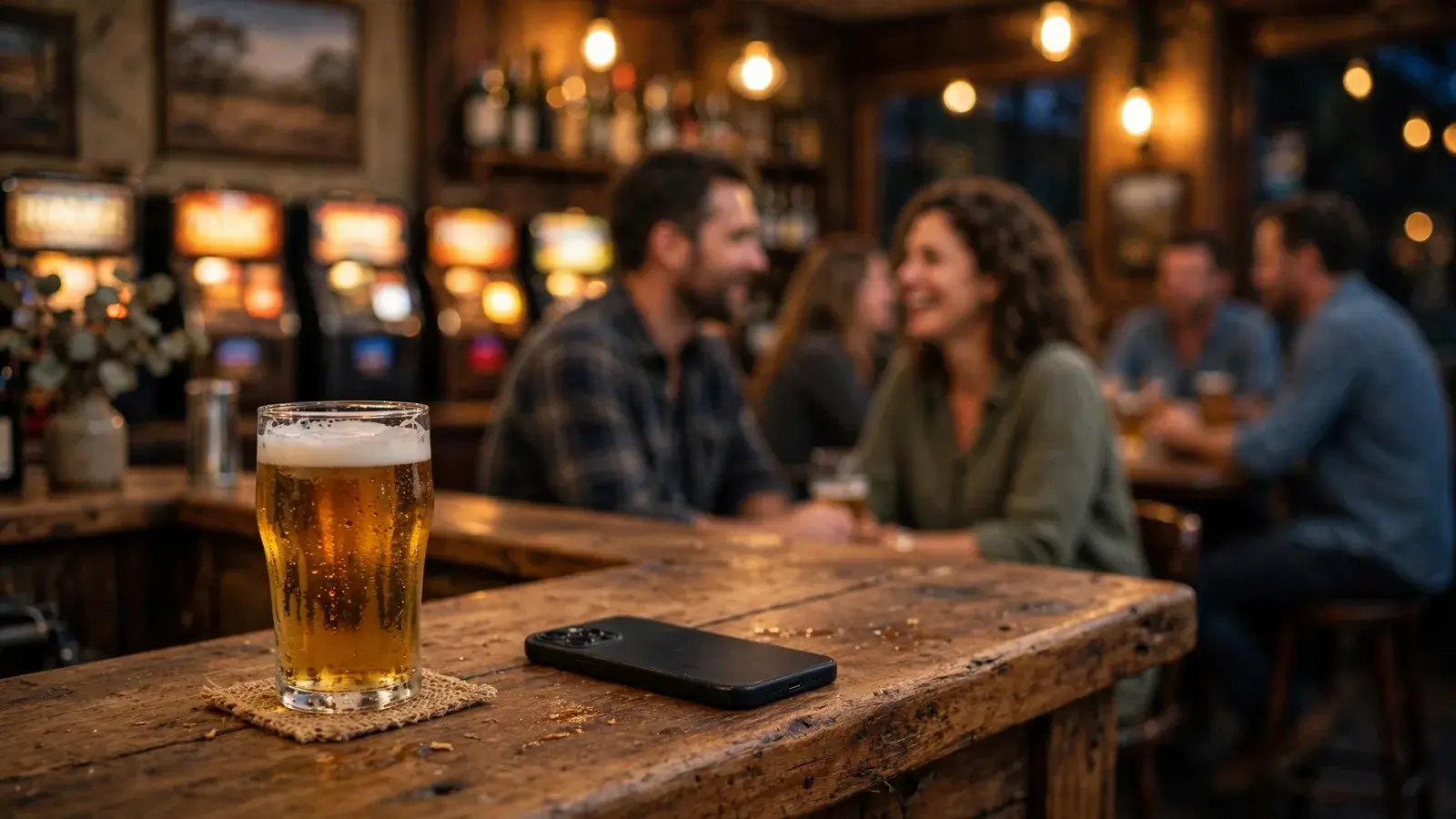
A physical pokie machine is a piece of equipment found in a venue. A digital slot is software displayed on a screen. They may be discussed with similar language because both refer to slot-machine-style games, but the terms describe different formats: one is a physical machine, while the other exists as a digital product.
That distinction matters when you come across wording such as “Dragon Link machine” or “Dragon Link online”. The word *machine* may be used loosely in conversation to mean a game, even when the person is referring to something on a screen rather than a cabinet in a venue. The wording alone does not tell you whether a particular physical machine or digital game exists, or whether the two formats correspond to one another.
A physical machine has a location and a tangible interface. A digital game is accessed through software on a screen. That difference affects what the words describe, not what you can infer about any named game. A familiar name attached to both “machine” and “online” does not, by itself, establish that there is a digital version of the physical product, or that a particular online product has the same design or operation.
If you’re looking at Dragon Link online pokies in Australia in 2026, operator details can help you decide what to check before choosing where to play. Use this list as a starting point and confirm the terms that apply to you.
-
LuckyVibe
- License
- Curacao Gaming Control Board OGL/2023/176/0095 (Hollycorn N.V.)
LuckyVibe lists a Curacao Gaming Control Board licence, OGL/2023/176/0095, held by Hollycorn N.V.
-
Lucky Dreams
- License
- Curacao
- Min. deposit
- A$20 (POLi)
Lucky Dreams lists a Curacao licence and a minimum deposit of A$20 via POLi.
-
LevelUp Casino
- License
- Curacao eGaming OGL/2023/174/0082 (Dama N.V.)
- Min. deposit
- A$15
LevelUp Casino lists a Curacao eGaming licence, OGL/2023/174/0082, held by Dama N.V., and a A$15 minimum deposit.
-
Playfina Casino
- License
- Curacao eGaming (Hollycorn N.V., since 2017)
- Min. deposit
- A$20-30 (depends on the offer)
Playfina Casino lists a Curacao eGaming licence held by Hollycorn N.V. since 2017. Its minimum deposit is A$20–30, depending on the offer.
-
SpinsUp
- License
- Curacao Gaming Control Board OGL/2023/174/0082 (Dama N.V.)
SpinsUp lists a Curacao Gaming Control Board licence, OGL/2023/174/0082, held by Dama N.V.
-
Vegaz Casino
- License
- Curacao OGL/2024/1335/0780
- Min. deposit
- EUR 20
Vegaz Casino lists a Curacao licence, OGL/2024/1335/0780, and a minimum deposit of EUR 20.
-
Bizzo Casino
- License
- Curacao Gaming Control Board (TechSolutions Group N.V.)
Bizzo Casino lists a Curacao Gaming Control Board licence held by TechSolutions Group N.V.
-
JustCasino
- License
- Curacao Gaming Control Board
JustCasino lists a Curacao Gaming Control Board licence.
-
Kingmaker
- Payout speed
- crypto ~90 minutes, fiat 1-5 days
- Min. deposit
- A$30
Kingmaker lists a A$30 minimum deposit. Its stated payout speed is around 90 minutes for crypto and 1–5 days for fiat.
-
Roby Casino
- License
- Curacao eGaming (Roby Games Ltd)
Roby Casino lists a Curacao eGaming licence held by Roby Games Ltd.
Online play also does not mean that a physical machine has simply been copied onto a screen. Digital games are software products, and their presentation can be built for screens rather than for a cabinet. Without reliable information about a named product, it is not safe to infer its appearance, rules, controls or other details from the idea of a physical machine. The broad category tells you only that the subject is a digital slot-style game; it cannot confirm a particular game’s identity or characteristics.
Payment language is another separate matter. A game’s format does not tell you how it is paid for. For instance, Bitcoin pokies are digital slot games where Bitcoin can be used as the payment method. That describes a payment option for a digital game, not a physical machine, and it does not establish that any particular named game accepts Bitcoin. Payment claims need to be understood separately from claims about a game’s identity or format.
It is also useful to separate the words *machine*, *game* and *platform*. A machine is the physical equipment. A game is the software or entertainment product being described. A platform is the service or interface through which digital products may be presented. These terms are sometimes used interchangeably in casual descriptions, but they do not mean the same thing. Seeing a game name beside the word *casino* or *online* does not explain which of those things is being referred to.
This is why a search for a Dragon Link pokie machine can leave you with an unclear result. It might point to someone talking about a physical machine, a digital game, or a page using “machine” as a broad label. The phrase does not settle which meaning applies. Nor does a page’s use of a name establish that it is describing a product with the same features as another product carrying that name.

For a reader, the practical distinction is modest but important: physical-machine language concerns equipment in a venue; online-machine language generally refers to software presented digitally. The familiar vocabulary can make the two sound interchangeable, but they are not evidence of one another. A reference to a casino machine does not prove the existence of an online counterpart, and an online listing does not verify that a matching physical machine is available.
So when a description uses “Dragon Link” alongside terms such as *pokie machine*, *slot machine* or *online*, read the surrounding wording carefully. Those labels can indicate the kind of thing being discussed, but they do not independently substantiate a specific version, its features or its availability. The safest interpretation is to treat machine terminology as a format description only, unless the product itself is supported by clear and reliable information.
Free Play: What It Can and Cannot Tell You
Online pokies may be presented in free-play or real-money mode. The distinction is straightforward: free play does not involve staking your own money on a game session, while real-money play does. A title or page that mentions free play should therefore be read as a claim about a mode of access, not as proof that a particular game is available, that it works in a certain way, or that playing it for money is lawful.
That matters when you come across references to free Dragon Link pokies or a free online version of a Dragon Link slot machine. Those phrases can describe what someone is looking for, but they do not establish that a particular Dragon Link game or machine has been verified. Nor does a free-play label, by itself, tell you whether the version being described is an official product, where it can be accessed, or what its rules are. Keep the name and the mode separate: one refers to an asserted game identity; the other refers to whether money is at stake.

A free-play session can tell you only what is observable in that session. If a game is available in a free mode, you may be able to see how that mode is presented and interact with it without placing real-money wagers. But a session is not evidence that the same experience, terms or access would apply in a real-money setting. A free version may not establish anything about how a real-money version behaves, even if the two appear similar to a player. Do not treat a familiar-looking screen or a shared title as proof that all versions are identical.
Free play also cannot establish that a game will pay money. Activity or results within a session that uses no real-money stakes do not show that a player can withdraw a real-money win. The essential difference is not cosmetic: in one mode you are not gambling your money; in the other, you are. A free session may be useful for understanding the basic experience offered in that mode, but it cannot settle questions about real-money outcomes, payment arrangements or the terms attached to a separate mode.
This is why a “free” label deserves a narrow reading. It indicates, at most, that the material is describing play without a real-money stake. It does not automatically mean every part of accessing the game is cost-free, and it does not confirm that the label accurately describes what is offered. The available information should support any specific claim. If a page says “play free” but does not clearly distinguish that mode from real-money play, the wording leaves an important question unanswered.
A review of a purported Dragon Link game has the same limitation. A reviewer may describe a free session, but that description is not a substitute for evidence about the game’s identity or its real-money terms. Conversely, a review that discusses real-money play should not be read as proof that a free version exists. The two modes are related only in the broad sense that online pokies may offer a choice between them; one does not verify the other.
Do
- Keep the game identity and the play mode separate
- Look for clear explanations of which mode is being discussed
- Treat free play as a way to observe a specific session
Don't
- Use a free-play label as proof that a game is verified
- Infer real-money outcomes from a no-stake session
- Assume a free version establishes the rules of a paid version
The distinction can be easy to lose when pages use “free pokies,” “free slot” and similar expressions interchangeably. Such wording may refer to a no-stake mode, but the phrase alone is not a dependable description of a specific product. Before relying on a claim, look for a clear explanation of which mode is being discussed and what the claim actually establishes. If that explanation is absent, it is safer not to infer details from the wording.
Free play is not a test of whether real-money play is suitable, safe or permitted. Those are separate questions, and a no-stake session cannot answer them. It also does not turn an unverified game name into a confirmed product. In particular, a free Dragon Link reference should not be taken as confirmation of a particular machine, online title or version. The mode and the identity of the game require separate support.
In short, free play and real-money play are distinct modes, not interchangeable descriptions of one session. Free play can indicate that a no-stake option is being described; it cannot, on its own, verify a game’s identity, establish the terms of a real-money version or demonstrate that money can be won and withdrawn. Keep those limits in view whenever a page presents a free-play claim.

Real-Money Play and the Australian Legal Position
The legal position is different from the question of whether a website describes a game as available to Australian players. Under the Interactive Gambling Act 2001, operators must not provide real-money online casino games to people who are physically in Australia. That category includes pokies, as well as online poker and casino-style table games. A site’s wording, payment options or ability to load on a device does not change the rule.
This distinction matters when you encounter a page about playing Dragon Link for real money. The name in a page title does not establish that a particular game is available, and a claim of availability does not make the service lawful to provide in Australia. No locally licensed online casino may offer real-money pokies to Australian residents. The restriction concerns the operator providing the service; it is not a licence category that a local casino can obtain to offer online pokies here.
The law focuses on where the customer is physically located when the service is provided. An Australian resident travelling overseas is not in the same location for this purpose as someone using a site from within Australia. Conversely, a person in Australia is not outside the rules merely because the website is hosted elsewhere, uses a foreign currency or accepts a digital payment. The place from which the service is accessed is central to the Australian prohibition.
What an offshore licence means
The operators discussed in this context hold licences from offshore authorities, primarily Curacao eGaming or the Anjouan Gaming Authority. Those licences are not Australian authorisations. They do not override the Interactive Gambling Act or convert an offshore casino into a locally licensed provider.
Offshore Licences
Licences from authorities such as Curacao eGaming or the Anjouan Gaming Authority are not Australian authorisations and do not override the Interactive Gambling Act.
A foreign licence may indicate that an operator is subject to some rules in the jurisdiction that issued it. It does not give Australian players the protections that apply under Australian consumer law, and it does not make the operator’s real-money pokies lawful to provide to people in Australia. The distinction is important: a licence can exist while the service remains prohibited in the customer’s location.
Australian consumer protection laws do not apply to the offshore operators discussed here. If a disagreement arises, you cannot assume that the usual Australian consumer protections or complaint pathways will be available in the same way as they would be for a locally regulated business. A foreign regulator may have its own processes, but that is not the same as Australian oversight, and a licence name alone does not establish what practical remedy a customer would have.
The absence of local consumer protection is not a minor technicality. It affects the framework around a transaction, not simply the appearance of a site or the wording of its terms. Before treating a claim on an offshore website as a dependable promise, distinguish the operator’s statements from protections that Australian law actually provides. The latter do not extend to the offshore operators described here.
The rule concerns operators, not a local option
The Interactive Gambling Act prohibits operators from providing prohibited interactive gambling services to customers in Australia. Online casino-style games—including slots, poker, blackjack and roulette—fall within that category when offered for real money to people in the country. The legal boundary is therefore not between one kind of online casino and another, or between a well-presented site and a poorly presented one. It is between a service that may lawfully be provided in Australia and one that the law prohibits operators from providing.

The penalties set out for breaches are directed at those who provide or otherwise violate the Act. The maximum daily penalty is $360,000 for an individual and $1.8 million for a body corporate. These figures describe potential penalties under the law; they are not fees, deposits or charges for customers. The legal frame also does not make an Australian player criminally liable simply for using an offshore casino. That does not make the service lawful for the operator to provide, nor does it create Australian consumer protection for the player.
This difference between operator responsibility and customer liability is easy to blur in promotional copy. A claim that “players are not prosecuted” would not answer whether the service itself is legal, whether it is protected by Australian law, or whether a customer can rely on the operator’s promises. Those are separate questions. In Australia, the operator-facing prohibition and the lack of consumer-law coverage for offshore operators remain significant even where the customer is not subject to a fine or criminal prosecution for playing.
Access does not settle legality
An offshore website may be visible in search results or may attempt to accept customers from Australia. That does not demonstrate regulatory approval. Australian authorities actively block and enforce restrictions against prohibited offshore online casino services. A site’s availability at a particular moment is not a legal endorsement, and a blocked or changing website is not evidence that the underlying service has become permitted.
Legal Prohibition
Under the Interactive Gambling Act 2001, operators are prohibited from providing real-money online casino games, including pokies, to people physically located in Australia.
Nor should an age requirement be confused with permission to provide the service. Real-money gambling is for adults aged 18 or older, but meeting an age threshold does not make an otherwise prohibited online casino service lawful in Australia. Age checks and identity checks are operator procedures; they do not replace Australian authorisation.
For the same reason, references to “real money” on a page about Dragon Link should be read as a description of what the page claims, not as confirmation of a lawful Australian offering. The legal status does not turn on whether a page uses the words “pokie”, “slot” or “casino”, nor on whether the game is presented as a particular title. The relevant issue is the provision of real-money online casino gambling to a person in Australia.
This page is affiliate material and may include sponsored links. That disclosure does not change the legal position or amount to an endorsement of an offshore service. A commercial link cannot supply local licensing, restore Australian consumer protections or make a prohibited service lawful. For a reader assessing a real-money claim, those limits matter more than a site’s description of its own status.
What Is Verified About Dragon Link in 2026
The name “Dragon Link” appears in searches for online pokies, including searches focused on Australia. A name alone, however, does not establish which game or product someone means. It cannot confirm that a particular digital game exists, that it is available to people in Australia, or that it has been released or updated in 2026.

That distinction matters when a familiar name is repeated across pages, listings or posts. Repetition can make a claim look settled without adding evidence about the product itself. A page using “Dragon Link” in its heading may be referring to a game, using the words to attract visitors, or discussing the term without identifying a specific version. The wording is not proof.
The same caution applies to descriptions of a “Dragon Link” pokie or online slot. A title does not substantiate claims about how a game works, what its screen looks like, who made it, or what features it includes. Those details would need to be tied to an identifiable product and supported by reliable information. Without that connection, presenting them as facts would risk describing a different game—or inventing one.
The year in the search phrase does not change that standard. “2026” may reflect when someone is looking for information, but it does not establish a release date, a current version or availability during that year. A claim that the game is newly launched, updated or accessible in Australia requires evidence of the specific product and the relevant date. The year in a page title is not such evidence.
Nor does the phrase “Dragon Link online pokies Australia” settle whether a result refers to an actual game that can be accessed from Australia. A search result or operator page can use a title without demonstrating the identity or status of the product it names. The reader should distinguish a statement about a name from evidence about a particular game.

For a claim to be meaningful, it should identify the product clearly and connect the claimed details to that product. If a page gives no way to tell what version it means, confident descriptions of its design, mechanics or availability are not dependable. More detail in the wording does not make the underlying identification more certain.
So the defensible point is narrow: “Dragon Link” is a name people use when looking for online pokies, but the name itself does not establish game-specific facts for 2026. Claims about a particular Dragon Link game should not be treated as confirmed merely because they appear beside the name. In Australia, that distinction is especially important: a product name or listing should not be mistaken for confirmation that real-money online play is lawfully offered to residents.
Slot Terminology Without Unsupported Game Claims
“Slot” and “pokie” are two names for the same broad category of digital game: a slot-machine-style game presented on a screen. “Pokie” is the familiar Australian term; “slot” is also widely used, particularly in international descriptions. Neither word, by itself, identifies a particular game, maker, version or set of features.
That distinction matters when a title is paired with either term. Calling something a “Dragon Link slot” or a “Dragon Link pokie” expresses a label or classification, but the wording alone does not establish that a particular digital game is available, what it looks like, or how it works. A title repeated across pages is not a substitute for reliable information about the product behind it.

The same caution applies to phrases that attach a jackpot or another themed-sounding name to Dragon Link. Those words may make a description sound specific, but they do not confirm a jackpot structure, a game edition or a machine with that name. Without substantiation, it is better to treat such combinations as labels rather than as descriptions of verified features.
“Slot machine” can also refer to a physical cabinet, while “online slot” or “online pokie” generally signals a digital game. The wording tells you the format being discussed, not whether a named title has been confirmed for that format. A phrase such as “golden century” or “spring festival” does not, on its own, establish a distinct Dragon Link game or theme.
The payment term can be equally descriptive rather than identifying. “Bitcoin pokies” means digital slot-machine games that accept Bitcoin as a payment method. It describes a payment category; it does not verify that any particular title accepts Bitcoin or is offered by a particular operator.
For readers, the useful distinction is between a category word and evidence about a specific product. “Slot” and “pokie” tell you what kind of game a description claims to concern. They cannot, without supporting details, confirm a title, machine, version, feature or payment option. A familiar name beside a familiar category term may look conclusive, but the terminology itself proves only the intended category.
Slot / Pokie
Broad category terms for digital slot-machine-style games; they do not identify a specific game or version.
Slot Machine
Generally refers to a physical cabinet found in a venue, as opposed to a digital online game.
Bitcoin Pokies
A payment category describing digital games that accept Bitcoin, not a specific game title.
Wins, Withdrawal Delays and Warning Signs
A large win can be followed by a withdrawal review, but a request for verification is not, by itself, proof that an operator is acting improperly. Operators may check an account after a significant win, and some may use security reviews to delay payment—particularly when the account is new or the withdrawal is the first large one. Treat claims about Dragon Link wins or bonus payouts cautiously: they do not establish how a particular operator will handle a withdrawal.
There are also routine reasons a payment may take time. An operator may have a queue of withdrawal requests awaiting approval, need identity checks to be completed, or process payments in batches during business hours. Those explanations are distinct from an unexplained or repeatedly extended review. Keep copies of the withdrawal request, any messages from the operator and documents you have submitted. Ask what remains outstanding and request a clear explanation in writing.
Be especially wary if you are told to deposit more money to release a pending withdrawal. Do not send another deposit to unlock it. A demand for additional funds is a warning sign, not a payment step or a reliable way to resolve a delay. Preserve the message and avoid following payment instructions that keep changing.
The phrase “security review” can sound definitive, but it does not tell you how long a review will take or whether the operator will approve the payout. A request for documents may be part of an account check; repeated demands, shifting explanations or pressure to pay again deserve particular caution. Do not assume that a win claim, a posted success story or a description of a bonus proves that a payout is available to you.
If you are dealing with a delayed withdrawal, distinguish between a stated verification requirement and a demand for new money. Keep records of both, and do not treat tips about winning or bonuses as a remedy for a payout problem.
An App Is Not Evidence of a Verified Game
A phone app bearing the Dragon Link name would not, by that label alone, establish who made it, whether it is genuine, or which game it contains. App names and descriptions are claims made by whoever publishes them; they are not proof of a connection to a particular machine or digital game. The same applies to a casino app that uses the name in its branding.
An app page may also combine several ideas: a game title, a casino’s name and a promise of mobile access. Those are separate claims. A casino app is software for accessing an operator’s services; it does not independently verify the identity or details of a game offered through it. A game name in an app description is not evidence of a particular release, version or feature.
Attention: A phone app bearing a game's name does not prove the app is genuine or that it is connected to a verified product.
The same care applies to a stated RTP. RTP means “return to player”: a theoretical measure used to describe the proportion of wagers a game is designed to return over extended play. It is not a prediction of what an individual will receive, and a number displayed in an app listing cannot establish which game or version it describes. Without reliable identification of the game and the basis for the figure, the number offers little useful assurance.
For Australian readers, an app is not a way around the legal position on real-money online casino games. The Interactive Gambling Act prohibits operators from providing those services to people located in Australia. Offshore operators are not covered by Australian consumer protection laws.
This page is affiliate material and may include sponsored links. That disclosure does not make a casino or gambling app a recommendation, nor does it verify a game or its claims. A download prompt, polished listing or familiar-sounding title is not a substitute for evidence—and should not be treated as one.
How Play and Payment Claims Should Be Checked
A description of how to play can refer to two different modes: free play and real-money play. They are not interchangeable. Free play does not involve wagering your own money, while real-money play does. In Australia, operators are prohibited from providing real-money online pokies to people in the country, so a page describing that mode should not be read as evidence that it is lawful or locally available.
Payment details answer a separate question. A general explanation of Bitcoin deposits or withdrawals describes a way funds may move between a wallet and an operator; it does not establish that a particular game is offered, that a named version exists, or that Australian residents can access it. The payment method and the game’s identity need separate substantiation. One does not prove the other.
The same caution applies to claims about playing or winning. Without reliable information about a specific game, instructions presented as Dragon Link strategies cannot be treated as verified guidance. A payment explanation, a game title in a page heading, or a claim that a game can be played online does not establish its mechanics or suggest a dependable way to win.
When assessing such claims, separate what is being asserted: whether a mode is described, whether a payment method is mentioned, and whether the named game and its availability are actually established. Treating those as distinct matters helps prevent a broad statement about Bitcoin from being mistaken for confirmation of a specific Dragon Link offering.
Happy and Prosperous: A Search Term, Not a Verified Feature
“Happy and Prosperous” may appear alongside Dragon Link in descriptions or page titles, but the wording should not be taken as proof that a Dragon Link game or machine with that name exists. A phrase attached to a familiar name can look like a formal title without identifying a confirmed product.
The distinction matters because a search result can combine words from a heading, a promotional label or a user’s description. None of those, by itself, establishes that the named game is available or that it has particular characteristics. The phrase should therefore be read as a label someone has used, not as evidence of a defined Dragon Link release.
The same applies whether the words are joined by “and” or an ampersand, or whether the page calls the subject a slot or a slot machine. Small differences in wording do not make the underlying claim more reliable. A reader looking for this name should avoid inferring a game’s identity, format or status from the phrase alone.
It would be misleading to attach a theme, feature, version or availability claim to it.
That boundary is useful beyond this phrase. Names can be repeated across pages even when they do not point to a clearly established product. Treating repetition as confirmation only makes an uncertain label sound settled.